


- THE BRAIN-BODY METHOD
Exercise Is Medicine. We Made It a Method.
Mental Health Is More Than Mental.
Mental health can affect how you think and feel, but it can also affect how you breathe, sleep, move, and experience your body. And while the connection between exercise and mental health is well established, movement and psychological support are still often approached separately.
The Brain-Body Method brings them together. By pairing psychology-informed content with structured, research-based movement designed for specific mental health conditions, we turn the mind-body connection into a system you can actually put into practice.
THE BRAIN-BODY METHOD
Every Part Has a Purpose.
- PHASE 1: PREPARE
5 Minutes
Before you sweat, you check in. Each session begins with a brief emotional check-in followed by guided mental health content designed to educate, motivate, or challenge you around the day’s mental health focus, preparing you for the movement ahead.
- PHASE 2: MOVE
35 Minutes
This is where research becomes movement.
Depending on your program, you’ll complete cardio, strength training, or other forms of exercise intentionally selected around research for your specific mental health condition. The type, intensity, and progression of movement are all designed with purpose, making exercise an active part of how you support your mental well-being.
- PHASE 3: REFLECT
5 Minutes
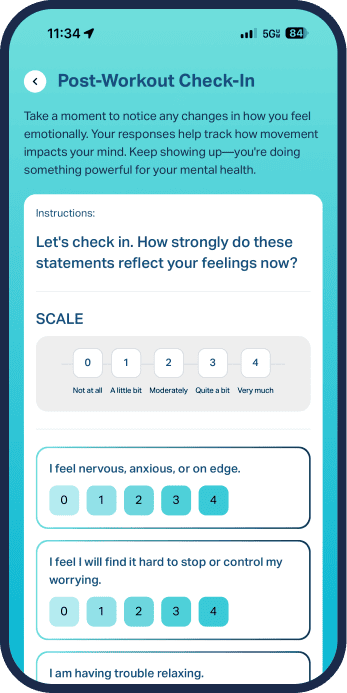
After you move, you check in again and see a comparison of how you felt before and after your workout. You’ll then finish with a closing counseling-informed video that continues and concludes the topic introduced before your workout, bringing the day’s mental health lesson full circle.
The Physiology of Healing.
- NEUROPLASTICITY
Brain-Derived Neurotrophic Factor (BDNF)
Exercise actively increases BDNF, a crucial protein that acts like fertilizer for the brain, helping you build new, resilient neural pathways.
- STRESS RESPONSE
Cortisol & Adrenaline Management
Physical activity interacts with the body’s stress-response systems, including hormones such as cortisol and adrenaline. With regular exercise, the body may become better equipped to manage and recover from stress, supporting greater resilience over time.
- NEUROTRANSMITTERS
Serotonin & Dopamine Optimization
Targeted physical movement naturally stimulates the release of the exact neurotransmitters required to combat the lethargy and anhedonia associated with depression.
A Structured Path, Not a Random Workout.
Proof of Concept